Saturday, October 4, 2008
Breaking News...Another Writer Joining Green Nuclear Butterfly
Tuesday, September 23, 2008
Speaking of Federal Bailouts...Time To Just Say No To Nuclear!
Tuesday, September 23, 2008
Speaking of Bailouts...Is It Time To STOP NUCLEAR INDUSTRY BAILOUT?

Saturday, December 1, 2007
Mobilize To Stop Loan Guarantees Next Week
Next week the House and Senate will try to reconsile their two versions of the Energy Bill, and neither version is very friendly towards truly sustainable energy sources. More importantly, the nuclear industry will have all Lobbyist on Deck to try to push through ONE HUNDRED PERCENT loan quarantees for new reactor builds. It is imperiative that the entire GREEN community be on the phones next week doing everything possible to have the loan quarantees and the $50 Billion nuclear gift GUTTED from any bill sent to the White House.Already, Constellation Energy is trying to use fear, threats and intimadation to force through the 100 percent loan guarantees, announcing this past week that they will not break ground on a new reactor build next year without said loan quarantees in place...so, stop the loan guarantees, and we stop the new builds in their tracks, slow down the Nuclear Renaissance train.
So, this weekend send emails to every one of your elected officials in Washington DC, and starting Monday lets be prepared to SWAMP the House and Senate switchboards with calls demanding that the $50 billion in loan guarantees be stripped from the Energy Bill.
AP
Industry Pushes Nuclear Loan Guarantees
Wednesday November 28, 1:25 pm ET
By Dan Caterinicchia, AP Business Writer
http://biz.yahoo.com/ap/071128/constellation_nuke_loans.html?.v=1
Constellation Energy Executive Says Nuclear Plans Will Be Delayed Without Loan Guarantees
"If the loan-guarantee program is able to materialize in early 2008 so we are able to secure loan guarantees for construction of a new plant at the end of 2008," the company's board could move forward, said Michael Wallace, president of Constellation Energy Generation Group. "If it doesn't, we won't."
The Energy Department last month said it will guarantee loans for up to 80 percent of the construction cost of new nuclear reactors, but that budget constraints mean the earliest any company proposing a new reactor could benefit is 2009.
Energy Secretary Samuel Bodman said then that he would seek "substantial" budget increases for loan guarantees to support seven to eight nuclear plants.
"The trend line is positive and encouraging, but today we're not there," Wallace said at a conference in Washington, referring to the industry's ongoing dialogue with the Energy Department, Congress and the White House. But he said it's not a question of whether it will happen, but when.
Three companies already have submitted complete construction and operating license applications for new reactors to the Nuclear Regulatory Commission, and Constellation filed a partial application earlier this year for a proposed new reactor in Lusby, Md.
Saturday, November 17, 2007
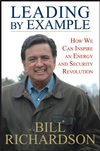
Former Energy Secretary Richardson
Former Energy Secretary Richardson has called energy security (Albuquerque Tribune) the most important issue facing the United States. He calls for “a massive public and private investment to develop new technologies, particularly renewable technology.” The New Mexico governor once said (Billings Gazette) that he wants his state to be "the Saudi Arabia of Wind, Solar, and biomass."In December of 2006, he signed an executive order requiring state vehicles to use renewable fuels and state offices to have energy efficient appliances (PDF). In this interview with Tavis Smiley, Richardson says that the United States needs to reduce the amount of imported oil to ten percent of its total from the current 65 percent.
He suggests achieving this by "getting the 100 mile per gallon (mpg) car into the marketplace," according to his campaign. He also says the CAFE standards should reach 50 mpg by 2020.
Richardson says as president, he would push for legislation requiring a 20 percent improvement in energy productivity by 2020. He also believes "carbon clean coal" (Grist) wil play a role in the United States' energy future.
From:
Council on Foreign Relations
Transcript from the Nevada Democratic Debate:
Richardson: Well, you mentioned all the labs, Argonne, Yucca Mountain. I was in charge of them.
Here's what you do. First, the future is renewable. It's not oil. It's not coal. It's not nuclear.
What you do with the waste is you don't put it in Yucca Mountain. All my life, as secretary of energy, as a congressman, I oppose the site, for environmental reasons, water saturation.
I don't think the answer also is in regional sites. There is a technological solution, a scientific solution.
What I would do, I would turn Yucca Mountain into a national laboratory. We have the greatest brains in our national lab scientists. We need to find a way to safely dispose of nuclear waste. There is a technological solution, but while we do that, we shouldn't be giving the nuclear power industry all of these advantages in the Senate bills that are coming forth, or subsidies. Oil, coal and nuclear are getting most of the subsidies.
We need an energy revolution in this country to shift from fossil fuels to renewable sources by 50 percent by the year 2020. Eighty percent reduction of greenhouse gas emissions are mandated.
We need to have 30 percent of our electricity renewable, and it's going to be also the American people -- I going to say this honestly -- sacrificing a little bit when it comes to appliances, when it comes to being part of an energy efficiency revolution.
From: MSNBC
Wednesday, November 7, 2007
Mythbusters to Test Cockroach Radiation Myth
(photo: Summer Rayne Oakes and her pet giant Madagascar hissing cockroach Hercules.)Posted by Zonk on Fri Oct 19, 2007
redwoodtree writes
"An article on the site for the Tri-City Herald sums it up perfectly:
'Contrary to popular belief, not a significant amount of research goes into cockroach radiation.'
To test the old saw about 'the cockroaches being the only survivors of a nuclear war' Discovery Channel's Mythbusters are going out to Hanford Site, where plutonium was manufactured for the first nuclear bomb. It's the single most polluted nuclear waste site in the U.S.
The Mythbusters are going to take cockroaches and other insects and apply successively higher doses of radiation in a controlled setting."
The show is expected to air in about 4 months.
Discovery Channel testing cockroach resistance to radioactivity
Published Friday, October 19th, 2007
The Associated Press
RICHLAND, Wash. (AP) - Can you save yourself by jumping in a falling elevator? Is a penny dropped from the top of the Empire State Building lethal? Would cockroaches survive a nuclear holocaust that killed everything else?
The final question is being tested this week at the nearby Hanford nuclear reservation by a team from the "Mythbusters" show on the Discovery Channel, which expects to air the episode in about four months.
"It's been on the original list of myths since day one," said Kari Byron, who appears on the cable television series and was in town with Grant Imahara and Tory Belleci for the tests.
The crew is using an irradiator in the basement of Hanford's 318 Building just north of Richland.
Pacific Northwest National Laboratory usually uses the device to calibrate dosimeters, which measure radiation exposure to humans and animals, and to check for radiation damage of video cameras, fiber optic cables and other equipment.
Lab operators agreed to the research for purposes of science education and workers donated their time, in some cases using part of their vacation allotments.
On Thursday afternoon, Byron and Imahara were cramming their uncooperative critters into a specially built roach condo to be exposed in the irradiator.
"I had to put myself in quite the mind-set to do it," Byron said.
A scientific supply company sent 200 cockroaches for the tests, "all laboratory-grade, farm fresh," Imahara said.
A control group of 50 will get no radiation, 50 others will be exposed to 1,000 rad, a lethal load of radiation for humans, 50 will be exposed to 10,000 rad and the last 50 to 100,000 rad.
The bugs will be watched over the next couple of weeks to see how soon they die.
"Contrary to popular belief, not a significant amount of research goes into cockroach radiation," Imahara said.
Flour beetles and fruit flies, also being irradiated for comparison, were a snap compared with the cockroaches, which did not take well to being corralled within a tiny block arrangement designed to make sure each bug gets the same dosage.
"They are very fast. They are very aggressive. They want to get away," Byron said. "They are opportunists."
The surviving bugs get a chauffeured ride back to San Francisco. A "Mythbusters" employee has been detailed to drive them because airlines won't let them in the passenger cabin and they can't be placed in the baggage hold without wrecking the experiment.
"We have to maintain reasonable temperature and humidity so they don't go into shock," Imahara said.
The show, while perhaps best known for exploding outhouses and cement trucks, presents good examples of scientific method and encourages developing a questioning attitude, said Michelle Johnson, a technical group manager for the national lab.
"(Viewers) should learn that things don't glow if exposed to radiation," she said. "And they won't be radioactive after being exposed to radiation."
But will the roaches grow really, really large?
"Some of our staff do believe in comic book logic," Byron said.
And if that happens, it will be a really good show, she said.
Thursday, October 4, 2007
If A Radio Show Upsets Folks Over At The NEI Blog, We Need to Give our Readers A Chance to Listen To It!
KUOW Program Archive
The Conversation
10/3/2007
France.
Is Nuclear the New Green Power?
With virtually no greenhouse gas emissions (A major nuclear industry lie), nuclear reactors are touted by some as part of the solution to global warming. (Let's see some studies on Nuclear Energies Thermal Discharge contributions to Global Warming.) Over the next 15 months, the Nuclear Regulatory Commission expects a tidal wave of permit applications for up to 28 new reactors. Some leading environmentalists, including James Lovelock, the founder of the Gaia idea, support the idea of nuclear energy as a solution to global warming. (Curious, does James also support child murder? How many birth defects have been caused by the effluents from nuclear reactors?) Is nuclear energy really clean energy? Does the threat of global warming overshadow the threat of nuclear waste? The nuclear industry gets about $9 billion a year in federal subsidies (Best up that figure significantly), trailing only oil and coal in federal energy aid. How are new nukes different from old nukes? (The public in host communities have far fewer protections due to greatly reduced Safety Margins.) Do you think public money should go into building them?
Also, astronomers are trying to measure light pollution by asking you to look at the constellations. We'll find out how that works.
Thomas Cochran is senior scientist at the Natural Resources Defense Council.
John Holdren is Director of the Science, Technology, and Public Policy Program at Harvard University.
Dennis Ward is an astronomer with University Corporation for Atmospheric Research in Colorado.
Related Links:
Thursday, May 17, 2007
Recycling Nuclear Waste Too Dangerous
INSIGHTS: Recycling Nuclear Waste Too Dangeroushttp://www.ens-newswire.com/ens/may2007/2007-05-16-insalv.asp
By Robert Alvarez
Between 1993 and 1999, Robert Alvarez served in the Department of Energy as a senior policy advisor to the secretary of energy and deputy assistant secretary for national security and the environment. (Photo courtesy Robert Alvarez)Members of Congress, who will soon vote on the President's request for $405 million for GNEP in fiscal year 2008, should recognize that GNEP has no chance in our lifetimes of brightening the prospects of finding safe ways of nuclear fuel disposal.
The foreign reactor wastes, along with spent fuel from the U.S. reactor fleet, would be reprocessed to reduce the amount that would go deep underground. Nuclear explosive materials, such as plutonium, would also be separated and converted to less troublesome isotopes in a new generation of reactors.
If placed in a crowded area, a few grams of these wastes would deliver lethal doses in a matter of seconds. Concentrations could be so large that if they were disposed of under current standards in shallow land burial as low-level wastes, shortly after separation they would have to be diluted to a volume as large as 500 million cubic meters, enough to fill 500 Empire State Buildings.
{Robert Alvarez is a senior scholar at the Institute for Policy Studies in Washington, DC. Between 1993 and 1999, he served as a senior policy advisor to the secretary of energy and deputy assistant secretary for national security and the environment.}

Saturday, March 3, 2007
ROUTINE RADIOACTIVE RELEASES FROM NUCLEAR REACTORS - IT DOESN’T TAKE AN ACCIDENT
What you are not supposed to know:1 ~ It doesn’t take an accident for a nuclear power plant to release radioactivity into our air, water and soil. All it takes is the plant’s everyday routine operation, and federal regulations permit these radioactive releases.
2 ~ Radioactivity is measured in "curies." A large medical center, with as many as 1000 laboratories in which radioactive materials are used, may have a combined inventory of only about two curies. In contrast, an average operating nuclear power reactor will have approximately 16 billion curies in its reactor core. This is the equivalent long-lived radioactivity of at least 1,000 Hiroshima bombs.
3 ~ A reactor’s fuel rods, pipes, tanks and valves can leak. Mechanical failure and human error can also cause leaks. As a nuclear plant ages, so does its equipment - and leaks generally increase.
4 ~ Some contaminated water is intentionally removed from the reactor vessel to reduce the amount of the radioactive and corrosive chemicals that damage valves and pipes. The water is filtered and then either recycled back into the cooling system or released into the environment.
5 ~ A typical 1000-megawatt pressurized-water reactor (with a cooling tower) takes in 20,000 gallons of river, lake or ocean water per minute for cooling, circulates it through a 50-mile maze of pipes, returns 5,000 gallons per minute to the same body of water, and releases the remainder to the atmosphere as vapor. A 1000-megawatt reactor without a cooling tower takes in even more water--as much as one-half million gallons per minute. The discharge water is contaminated with radioactive elements in amounts that are not precisely known or knowable, but are biologically active.
6 ~ Some radioactive fission gases, stripped from the reactor cooling water, are contained in decay tanks for days before being released into the atmosphere through filtered rooftop vents. Some gases leak into the power plant buildings’ interiors and are released during periodic "purges" and "ventings." These airborne gases contaminate not only the air, but also soil and water.
7 ~ Radioactive releases from a nuclear power reactor’s routine operation often are not fully detected or reported. Accidental releases may not be completely verified or documented.
8 ~ Accurate, economically-feasible filtering and monitoring technologies do not exist for some of the major reactor by-products, such as radioactive hydrogen (tritium) and noble gases, such as krypton and xenon. Some liquids and gases are retained in tanks so that the shorter-lived radioactive materials can break down before the batch is released to the environment.
9 ~ Government regulations allow radioactive water to be released to the environment containing "permissible" levels of contamination. Permissible does not mean safe. Detectors at reactors are set to allow contaminated water to be released, unfiltered, if below "permissible" legal levels.
10 ~ The Nuclear Regulatory Commission relies upon self-reporting and computer modeling from reactor operators to track radioactive releases and their projected dispersion. A significant portion of the environmental monitoring data is extrapolated – virtual, not real.
11 ~ Accurate accounting of all radioactive wastes released to the air, water and soil from the entire reactor fuel production system is simply not available. The system includes uranium mines and mills, chemical conversion, enrichment and fuel fabrication plants, nuclear power reactors, and radioactive waste storage pools, casks, and trenches.
12 ~ Increasing economic pressures to reduce costs, due to the deregulation of the electric power industry, could further reduce the already unreliable monitoring and reporting of radioactive releases. Deferred maintenance can increase the radioactivity released - and the risks.
13 ~ Many of the reactor’s radioactive by-products continue giving off radioactive particles and rays for enormously long periods – described in terms of "half-lives." A radioactive material gives off hazardous radiation for at least ten half-lives. One of the radioactive isotopes of iodine (iodine- 129) has a half-life of 16 million years; technetium-99 = 211,000 years; and plutonium-239 = 24,000 years. Xenon-135, a noble gas, decays into cesium-135, an isotope with a 2.3 million-year half-life.
14 ~ It is scientifically established that low-level radiation damages tissues, cells, DNA and other vital molecules – causing programmed cell death (apoptosis), genetic mutations, cancers, leukemia, birth defects, and reproductive, immune and endocrine system disorders.
THIS INFORMATION SHEET IS INTENDED FOR REPRINTING AND, THEREFORE, IS NOT COPYRIGHTED
Nuclear Information and Resource Service
6930 Carroll Avenue Suite 340
Takoma Park, MD 20912
301 270 6477; 301 270 4291
nirsnet@nirs.org; www.nirs.org
Wednesday, February 14, 2007
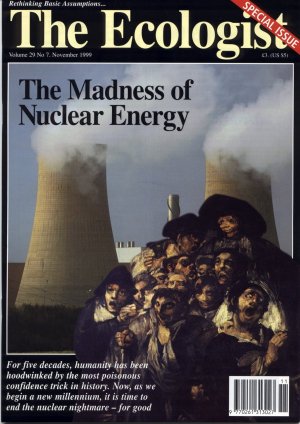
Ecologist Magazine Weighs In the Nuclear Debate
The Nuclear Dossier: The Ultimate Guide